DIY Colloidal Silver Generator: A Complete Step-by-Step Guide
Have you looked at pre-made colloidal silver generators only to be put off by the shocking price tags? It’s a common frustration. You want the benefits, but you’re wary of the cost and the questionable quality of many commercial products. The thought of building your own can feel intimidating-mixing electricity and water sounds complicated, and the online instructions can be confusing and vague, leaving you worried about safety.
Part of taking full responsibility for any DIY project includes being prepared for the unexpected. While the risks with this build are low when following instructions, it’s always wise to have a well-stocked first aid kit on hand. If you need to build or replenish yours, RestockYourKit.com offers a wide range of custom and pre-made kits for any situation.
I’m here to tell you it doesn’t have to be that way. My journey into electronics and personal health taught me that the most powerful solutions are often the simplest. Creating your own diy colloidal silver generator is not only surprisingly easy, but it’s also the best way to ensure you get a pure, high-quality product every single time, using ingredients you trust.
This complete guide will walk you through every step, from gathering a few common parts to safely assembling your device in under an hour. We’ll break down the science in plain English so you understand exactly what’s happening. Get ready to take back control of your wellness and build a tool that empowers your self-sufficiency for years to come.
First Principles: How a Colloidal Silver Generator Actually Works
At its heart, a colloidal silver generator uses a simple and elegant process called electrolysis. Don’t let the scientific term scare you; the concept is straightforward. It’s about using a controlled electrical current to pull microscopic particles from pure silver and suspend them in pure water. Understanding this fundamental process is the first step to safely building your own diy colloidal silver generator and knowing you’re creating a high-quality solution.
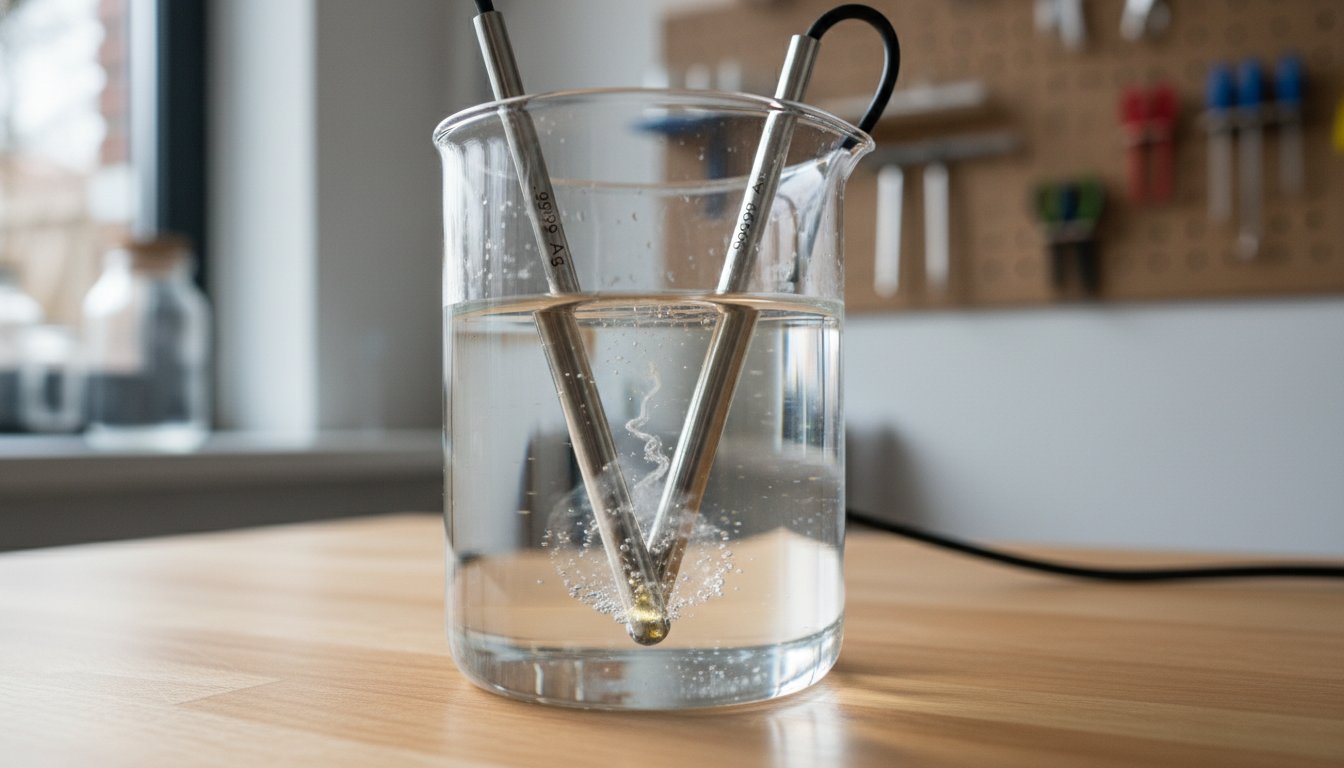
When you place two pure silver electrodes into distilled water and pass a low-voltage Direct Current (DC) through them, an electrical potential is created. This gentle but persistent current causes tiny particles and ions of silver to be released from the positive electrode and disperse into the water. While there are many legitimate medical uses of silver, particularly in wound dressings and medical devices, the solution you create at home is a different substance entirely, intended for your own personal research.
The Key Components and Their Roles
Every part of a generator serves a critical function. Using the wrong component can lead to an ineffective or, worse, a contaminated batch. Here is the simple breakdown:
- The Power Source: A low-voltage DC power supply is essential. Using Alternating Current (AC) or a voltage that is too high will create large, unstable silver particles and is not recommended.
- The Silver Electrodes: These are the source material. They must be made of high-purity silver to ensure that only silver, and no other metals, enters your solution.
- The Medium: Pure, steam-distilled water is the only acceptable medium. It acts as a clean carrier for the silver particles, without any interfering minerals or contaminants.
- The Container: A glass jar is non-negotiable. Plastic can leach unwanted chemicals into your solution, and a metal container would short-circuit the entire process.
Why Material Purity is Non-Negotiable
The safety and quality of your final product depend entirely on the purity of your starting materials. Cutting corners here introduces unknown variables and potential dangers. For instance, never use Sterling silver (.925), as the other 7.5% is typically copper and other metals like nickel, which you do not want to ingest. You must use silver that is at least .999 pure, with .9999 (“four nines”) being the gold standard for a clean process.
Likewise, using tap water, filtered water, or mineral water is a serious mistake. These water sources contain dissolved minerals and chemicals like chlorine. When you introduce electricity, these substances can react with the silver to form dangerous compounds like silver chloride, which the body cannot process effectively. Always start with pure, steam-distilled water for a safe and effective result.
Method 1: The Ultra-Simple Battery-Powered Generator (Beginner’s Build)
If you’re new to this journey, this is the perfect place to start. This battery-powered diy colloidal silver generator is the essence of simplicity and safety. Because it uses low-voltage DC power from common 9V batteries, the risk of electrical shock is virtually zero. It’s also completely portable, allowing you to make a fresh batch anywhere. The trade-off for this simplicity is speed and control; this method is slower than more advanced setups, and judging the final concentration is more of an art than a science. But for your first build, you can’t beat its reliability.
Materials & Tools Checklist
You can find most of these items at any electronics or hardware store. The one non-negotiable is the purity of your silver and water-this is critical for a quality end product.
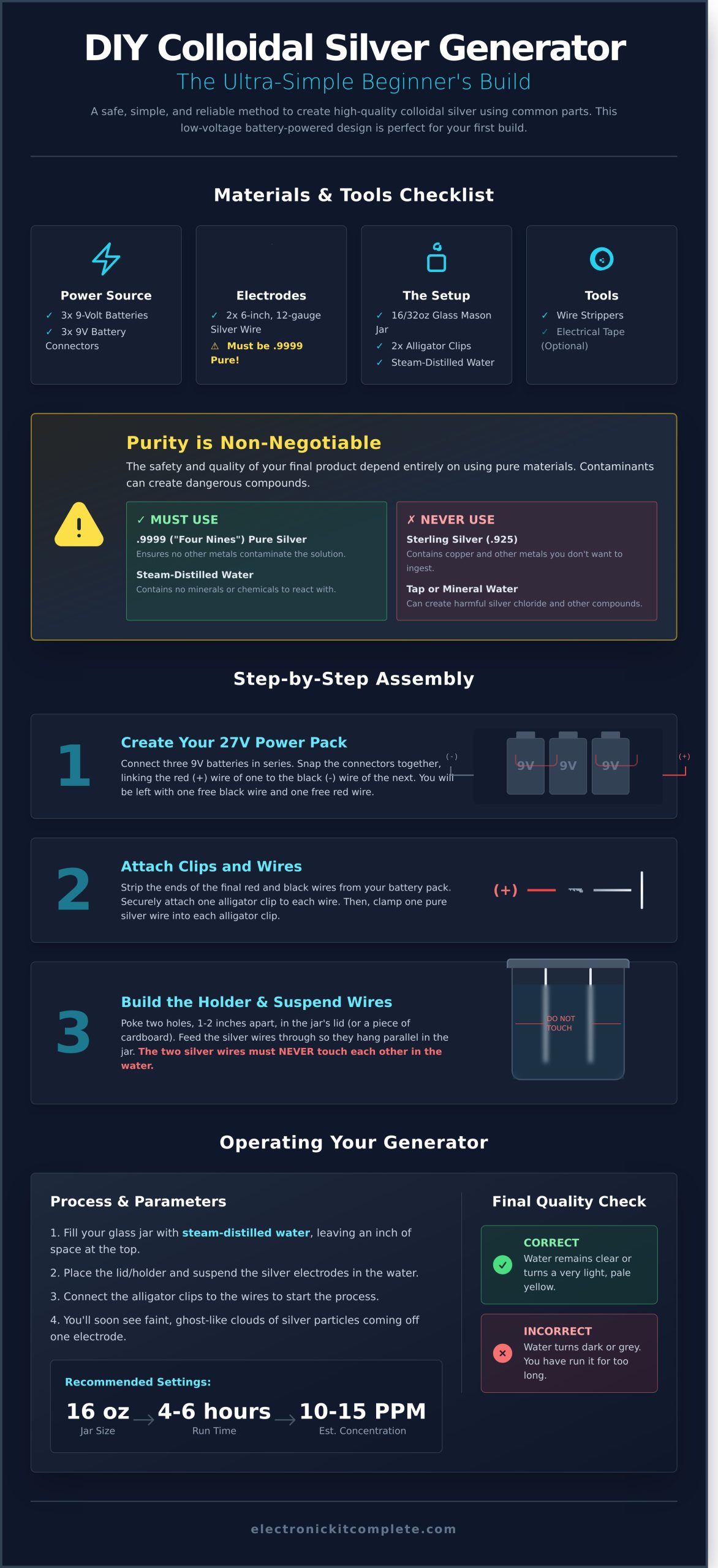
- Power Source: Three 9-volt batteries and three 9V battery snap connectors.
- Electrodes: Two 6-inch strands of 12-gauge, .9999 (four nines) pure silver wire. Do not use sterling silver or any lower purity.
- The Setup: A 16 or 32-ounce glass Mason jar, two alligator clips, and steam-distilled water.
- Tools: Wire strippers and optional electrical tape for securing connections.
Step-by-Step Assembly Instructions
Step 1: Create Your Power Pack. Connect your three 9V batteries in series. Snap a connector onto the first battery. Take the red (positive) wire from that connector and the black (negative) wire from a second connector and twist them together. Now, take the red wire from the second connector and twist it to the black wire of the third. You’ll be left with one black wire on the first battery and one red wire on the last battery. This creates a 27-volt power source.
Step 2: Attach Clips and Wires. Use your wire strippers to expose a small amount of wire on your final red and black leads from the battery pack. Attach an alligator clip to each lead. Now, attach one of your pure silver wires to each alligator clip.
Step 3: Build the Holder. The most important rule is that your two silver wires must never touch each other in the water. An easy way to prevent this is to poke two holes in the plastic lid of your Mason jar, about one to two inches apart, and feed the wires through. You can also use a piece of cardboard or wood laid across the jar’s mouth with two holes drilled in it. Suspend the wires so they hang parallel in the jar.
Operating Your Battery-Powered Generator
Fill your glass jar with steam-distilled water, leaving about an inch of space at the top. Place your holder and suspend the silver electrodes into the water. Now, simply connect the alligator clips to the wires. You’ll soon see faint, ghost-like clouds of microscopic silver particles coming off one of the electrodes. While it’s running, it’s a good idea to review the official NCCIH safety information on colloidal silver to be fully informed. For a 16-ounce jar, run the generator for 4-6 hours to achieve an estimated 10-15 PPM concentration. The water should remain clear or have a very light, pale yellow tint. If it turns dark or grey, you have run it too long.
Method 2: The Constant-Current Plug-in Generator (Intermediate Build)
For those ready to move beyond the simple battery setup, this constant-current diy colloidal silver generator offers a significant upgrade in speed, consistency, and control. While the 9-volt battery method is a great start, its voltage drops as the battery drains, which can affect the final product. By using a plug-in DC power adapter, we get a steady, uninterrupted power source for more predictable results.
The real magic of this build is current limiting. This is a simple electronic circuit that acts like a gatekeeper, ensuring only a small, steady electrical current reaches the silver rods. Why does this matter? A controlled, low current helps create smaller, more uniform silver particles, which is what many believe is the key to a higher-quality solution. However, this method introduces wall power, so it’s essential to double-check every connection. I urge you to read the Mayo Clinic expert answers on colloidal silver to be fully informed about potential risks before you begin.
Sourcing the Right Components
Gathering the parts for this advanced diy colloidal silver generator is straightforward. You can find most of these online or at an electronics supply store. My personal experience shows these components work very well together:
- Power Supply: A 24V to 36V DC wall adapter is ideal. Make sure it has a standard barrel plug that you can buy a matching jack for.
- Current Limiting: The simplest way is using an LM317 adjustable voltage regulator IC with a single resistor to set the current. A single LED can also work in a pinch as a crude current limiter.
- Connectors: Upgrade from simple alligator clips to sturdier options like banana plugs or a terminal block for a more secure and reliable connection to your silver electrodes.
- Optional Additions: A small aquarium air pump (with tubing) or a magnetic stirrer will keep the water circulating, preventing particles from clumping together and ensuring an even reaction.
Assembly Guide for the Plug-in Model
The circuit is surprisingly simple. The power flows from the DC wall adapter into a DC power jack. From the jack, the positive wire goes to the input of the LM317 regulator circuit, and the circuit’s output then connects to one silver electrode. The negative wire from the jack connects directly to the other silver electrode, completing the circuit. Always ensure all connections are insulated and that no bare wires can touch.
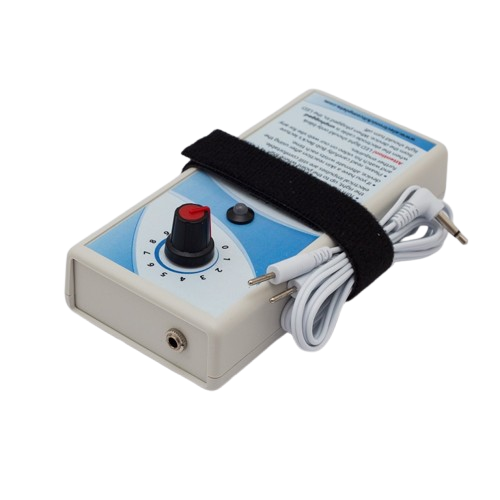
Not ready to build electronics from scratch? I completely understand. It’s why I focused on creating pre-made kits for health. See how the Bob Beck device uses simple, proven electricity for health without the complex assembly.
Crucial Safety Protocols and Best Practices
Please read this section carefully. I cannot stress this enough: when you build your own diy colloidal silver generator, you are taking full responsibility for the process. This isn’t the place to cut corners. We are working with electricity and water to create a product for your well-being. A mistake here can ruin your batch or, far more seriously, lead to electrical shock. Follow these simple, common-sense rules, and you will have a safe and successful experience every time.
Electrical Safety First
This is non-negotiable. Electricity demands respect. Always treat your circuit as if it is live, even when you think it’s off. The golden rule is to unplug the device from the wall before making any adjustments.
- Unplug Before Handling: Never, ever touch the silver electrodes, wires, or any part of the circuit while the unit is plugged into a power source.
- Build Away From Water: Assemble and test your electronics completely before bringing them near your jar of distilled water.
- Use a GFCI Outlet: For any plug-in model, using a Ground Fault Circuit Interrupter (GFCI) outlet is a must. These are the outlets with “test” and “reset” buttons, often found in kitchens and bathrooms. They are designed to shut off power instantly if they detect a fault, providing a critical layer of protection.
- Insulate Everything: Ensure all connections are secure, tight, and properly insulated with electrical tape or heat-shrink tubing to prevent accidental shorts.
Avoiding Contamination at All Costs
The purity of your final product depends entirely on the cleanliness of your process. Remember: garbage in, garbage out. Your goal is a pure suspension of silver in water, nothing else.
- Sterilize Your Gear: Thoroughly wash your glass jar with hot, soapy water, then rinse it multiple times with steam-distilled water to remove any soap residue or minerals from tap water. Clean your silver wires with a clean scouring pad and wipe them with a cloth dampened with distilled water before each use.
- Hands Off: Never touch the parts of the silver wires that will be submerged in the water with your bare hands. The oils from your skin can contaminate the batch. Use clean gloves or a paper towel.
- Cover Your Jar: During the electrolysis process, cover the top of the jar with a small piece of cardboard, a coffee filter, or a plastic lid with holes for the wires. This prevents dust and other airborne particles from falling into your water.
Proper Storage and Handling
Once you’ve made a successful batch, proper storage is key to preserving its potency. Light and certain materials can degrade your colloidal silver quickly. Always store your solution in dark-colored glass bottles, never plastic, as silver can react with it. Keep the bottles in a cool, dark cabinet away from direct sunlight and major appliances that produce electromagnetic fields (like microwaves). A properly made and stored batch can maintain its quality for several months.
By following these protocols, you ensure that your diy colloidal silver generator produces a clean and effective product safely. For those who prefer a ready-to-assemble solution with all the correct components, you can explore our tested kits at electronickitcomplete.com.
How to Test Your Homemade Colloidal Silver
You’ve followed the steps, your generator has been running, and you now have a jar of what looks like perfect colloidal silver. But when it comes to your health, we don’t guess. You don’t need an expensive laboratory to verify your work. With a couple of simple, low-cost tools, you can test each batch and gain the confidence that you’ve created a high-quality product right at home. This is the crucial final step that separates the amateurs from those who are serious about their results.
The Visual Check: Laser and the Tyndall Effect
The Tyndall effect is a fancy name for something simple: it’s how light scatters when it hits tiny particles suspended in a liquid. In a dark room, shine a common red laser pointer through your jar of solution. If you see a distinct, visible red line passing through the water, congratulations! This beam is proof that you have created a true colloid with silver particles suspended in the water. If there is no visible beam, the process is likely incomplete.
Using a TDS Meter to Measure PPM
A Total Dissolved Solids (TDS) meter is a must-have tool. It measures the concentration of conductive ions in the water and gives you a reading in Parts Per Million (PPM). While it primarily measures the ionic silver content, this is an excellent indicator of your solution’s overall strength. For most general purposes, a reading between 10-20 PPM is an ideal target. Simply dip the meter into your finished solution (after it has cooled) to get an instant reading.
Running these two simple tests will confirm that your diy colloidal silver generator has done its job correctly. The laser proves you have actual silver particles, and the TDS meter helps you confirm the concentration. Taking these extra minutes provides peace of mind and ensures you have a consistent, reliable batch every single time. A well-built diy colloidal silver generator, like the Bob Beck-inspired models we offer, makes achieving these quality results straightforward and repeatable.
For more information on reliable kits and components, feel free to visit us at electronickitcomplete.com.
Your Journey into DIY Health Electronics Starts Now
You’ve now seen just how accessible and empowering building your own tools can be. From understanding the core principles of electrolysis to assembling both a simple battery-powered unit and a more advanced plug-in model, you have the complete blueprint. Remember, the key to success lies not just in the build, but in following the crucial safety protocols and testing your final product. Creating your own diy colloidal silver generator is more than just a project; it’s a first step towards greater self-reliance.
If this journey into applied electronics has sparked your curiosity, I invite you to explore another fascinating area of bio-electricity. The same passion for discovery that led you here can open the door to understanding the pioneering work of Bob Beck.
We provide complete kits and spare parts based on his original, groundbreaking research. With worldwide shipping from Europe, you can get started no matter where you are. Intrigued by DIY health electronics? Discover the principles of bio-electricity with the Bob Beck Device. The power to learn and build is in your hands. Happy experimenting!
Frequently Asked Questions
What is the best voltage to use for making colloidal silver?
For making high-quality colloidal silver with small particles, a low DC voltage is best. We find that a range between 27 and 36 volts DC works perfectly. While a higher voltage can speed up the process, it often creates larger, less effective silver particles. Using a lower, controlled voltage ensures a slower, more stable reaction, resulting in a superior final product with a much smaller particle size, which is exactly what you want for maximum effectiveness.
Can I use tap water, filtered water, or spring water instead of distilled water?
No, you must only use steam-distilled water. This is the most critical rule. Tap water, filtered water, and even spring water contain minerals and impurities. These dissolved solids will react with the silver, creating silver compounds like silver chloride instead of pure colloidal silver. This not only makes the solution ineffective but can also be potentially harmful. For a pure and safe product, pure steam-distilled water is the only option.
How do I know when the colloidal silver is ready and the process is finished?
The simplest way to check is with a laser pointer. In a darkened room, shine the laser through the side of the glass jar. If you can see a distinct red line passing through the water (this is called the Tyndall effect), it means silver particles are successfully suspended. The process is usually complete when the water achieves a very faint, pale-yellow hue. Do not let it get dark, as this is a sign the particles are becoming too large.
Why did my colloidal silver turn yellow, gray, or cloudy?
A faint, transparent yellow color is often the sign of a perfect batch with very fine silver particles. However, if your solution turns dark yellow, gray, or becomes cloudy, it usually indicates a problem. This is typically caused by using water with impurities, running the generator for too long, or failing to clean the silver wires properly. This results in large particles that fall out of suspension, making the batch low-quality. It’s best to discard it and start over.
Is it significantly cheaper to make my own colloidal silver than to buy it?
Absolutely. The cost savings are the primary reason many people build their own. A single small bottle of colloidal silver from a health store can cost anywhere from $20 to $50. With a diy colloidal silver generator, your only recurring costs are for distilled water and the eventual replacement of your silver wires. You can produce gallons of high-quality colloidal silver for what you would pay for just one commercial bottle.
How often do I need to clean or replace the silver wires?
You must clean the silver wires before and after every single batch. During the process, a dark silver oxide builds up on the positive wire. Simply wipe this off with a paper towel or a green kitchen scouring pad until the wire is shiny again. The wires themselves will wear down very slowly. With regular use, a set of wires can last for a year or even longer, making your diy colloidal silver generator incredibly economical to operate.
Can I use a different metal, like copper, with this generator?
Absolutely not. You must only ever use .999 or .9999 pure silver wire. Using other metals like copper, zinc, or aluminum is extremely dangerous. These metals will release their own ions into the water, creating a toxic solution that should never be ingested. The generator and the entire process are designed exclusively for pure silver. Using any other material would be unsafe and produce a harmful substance, not colloidal silver.