
What Is Electrostatic Field Therapy? A Guide to Its History & Principles
Magnetic, electromagnetic, electrostatic… it’s easy to get lost in a sea of technical terms when you start exploring alternative wellness. You might be curious about using energy for health, but maybe you’re also a little skeptical or even concerned about safety. That’s completely understandable, especially when clear, simple explanations are so hard to come by. We believe knowledge should be accessible, which is why we’re going to cut through the noise and focus on one of the oldest and most fascinating approaches: electrostatic field therapy.
Think of this as your personal, no-nonsense guide. We’ll journey back through its surprising history, uncovering the pioneers who first experimented with static electricity for healing. We’ll break down the core scientific principles without the confusing jargon, so you can truly understand how it’s believed to work. By the end, you’ll not only grasp the difference between various field therapies but also feel confident and informed enough to decide if this unique wellness modality is something you want to explore safely for yourself.
Key Takeaways
- Learn to distinguish between different “field therapies” so you can research them more effectively and understand what makes each one unique.
- Grasp the simple scientific idea behind electrostatic field therapy and how it is thought to interact with the body’s natural processes.
- Discover the most common devices and methods used, from mats to handheld units, to see what this practice looks like in the real world.
- Get clear guidance on navigating the research, understanding safety considerations, and setting realistic expectations for your wellness journey.
Demystifying ‘Field Therapies’: What’s the Difference?
If you’ve started researching therapies that use electric or magnetic fields, you have likely encountered a confusing mix of terms: PEMF, Rife machines, static, pulsed, electromagnetic, and more. It’s easy to get lost in the technical jargon, and many sources use these terms interchangeably, which is incorrect and unhelpful for anyone trying to learn.
Understanding the fundamental differences is the first step to doing your own effective research. The broad field of Electrotherapy has a long history, but modern devices use vastly different principles. This guide is designed to cut through that noise, providing a clear and simple foundation so you know exactly what we’re discussing when we talk about electrostatic field therapy.
Electrostatic vs. Electromagnetic Fields
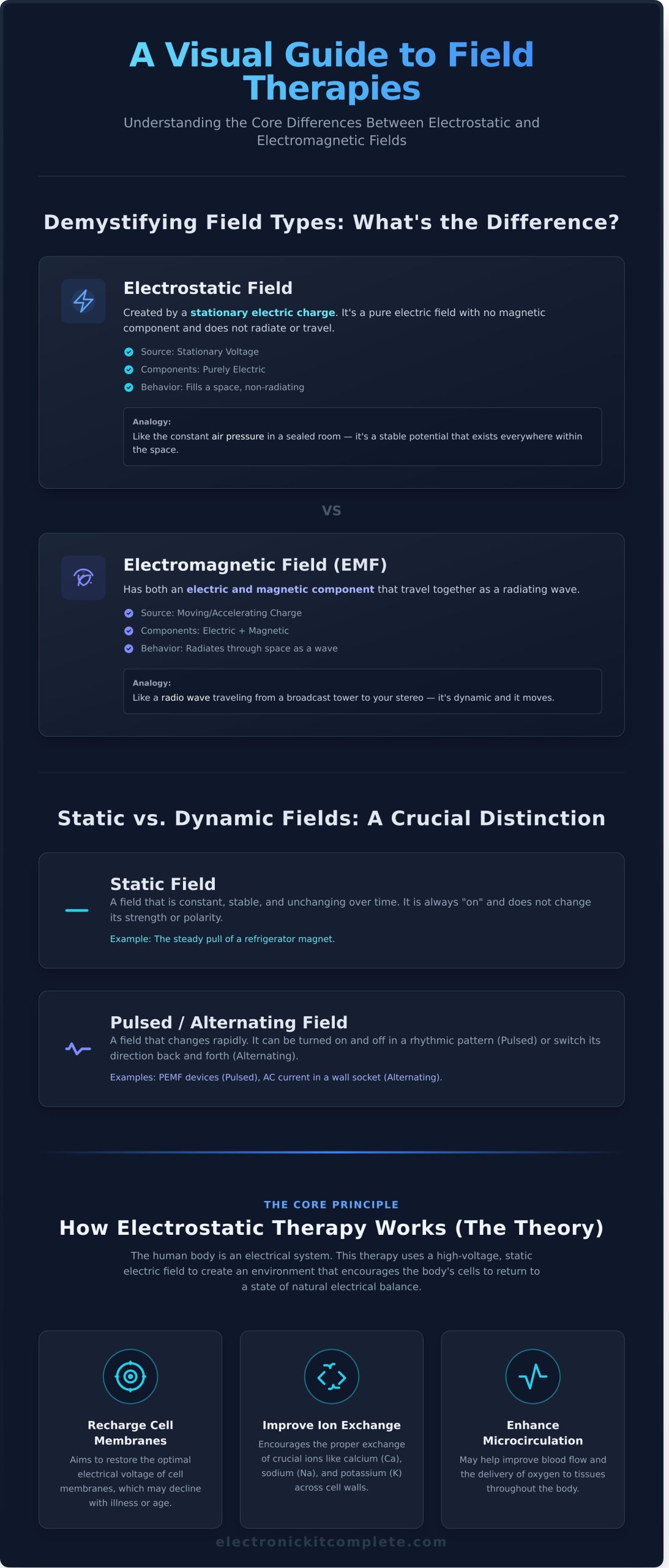
First, let’s clear up the biggest point of confusion. An electrostatic field is created by a stationary electric charge. The simplest way to think of it is like the air pressure in a sealed room-it’s a constant, stable potential that fills the space but isn’t moving or radiating outwards. It is a pure electric field, without a magnetic component.
An electromagnetic field (EMF), on the other hand, has both an electric and a magnetic component that travel together as a wave. A perfect analogy for this is a radio wave traveling from a transmitter to your stereo. It’s dynamic, it moves, and it radiates through space.
Static vs. Pulsed/Alternating Fields: A Crucial Distinction
The second key difference is how the field behaves over time. A static field is constant and unchanging. Think of the steady pull from a simple refrigerator magnet; it’s always “on” and doesn’t change its polarity or strength. This is the simplest and most fundamental type of field.
In contrast, an alternating field rapidly switches its direction back and forth, like the AC current in your home’s wall sockets. A pulsed field, commonly associated with PEMF devices, is a field that is turned on and off very quickly in a rhythmic pattern. For the purpose of this article, we are focusing exclusively on the gentle, constant, and stationary electric field used in electrostatic field therapy.
The Core Principles of Electrostatic Field Therapy
To understand electrostatic field therapy, we first have to appreciate a simple fact: the human body is an electrical system. Our nerves fire using electrical impulses, our heart beats due to an electrical rhythm, and every single cell maintains a tiny electrical charge to function. The core idea behind this therapy is to use an external electrical field to positively influence this internal bio-electrical environment. It’s about re-establishing balance in a system that is fundamentally electric.
What Is an Electrostatic Field? A Simple Primer
Think back to rubbing a balloon on your hair and watching it stick to a wall. That’s a basic electrostatic field in action! It’s an invisible field of energy created by a difference in electrical voltage between two points. Our environment is full of charged particles called ions (positive and negative). An electrostatic field can exert a gentle force on these particles, causing them to move and re-orient themselves without any current actually flowing through the body.
The Theory: How Does It Supposedly Affect the Body?
Proponents of this therapy believe that exposing the body to a high-voltage electrostatic field can have profound biological effects. The primary theory is that it helps restore the ideal electrical potential of our cell membranes. It is thought that healthy cells have a certain voltage, and that illness or aging can cause this voltage to drop. By immersing the body in this field, proponents claim it can help:
- Recharge cell membranes to their optimal state.
- Improve the exchange of ions like calcium, sodium, and potassium.
- Enhance microcirculation and oxygen delivery.
The goal isn’t to “shock” the system, but to create an environment that encourages the body’s own cells to return to a state of electrical balance.
Historical Roots: From Ancient Discoveries to Modern Explorers
Using electricity for wellness isn’t a new concept. As early as the 18th century, pioneers like Benjamin Franklin were exploring the effects of static electricity on the human body. Throughout the early 20th century, brilliant minds like Georges Lakhovsky and Royal Rife built devices based on the idea that bio-electric fields were key to health. While these early explorations were outside mainstream medicine, the fundamental idea of using fields for wellness continues to evolve. We can see its modern descendants in highly controlled clinical applications, as highlighted by recent Magnetic Seizure Therapy research from the National Institute of Mental Health, showing the enduring interest in this fascinating field.
Common Types and Applications of Electrostatic Therapy
When people talk about electrostatic field therapy, they aren’t referring to a single machine or method. The approach can look very different depending on the device and the goal. From whole-body systems found in wellness centers to small, portable units you can use at home, the core idea is to use a static electric field to interact with the body’s own electrical nature.
High Potential Therapy (HPT)
One of the most common forms is High Potential Therapy, or HPT. In a typical session, you sit on a special insulated chair connected to a machine that generates a high-voltage electrostatic field. The goal is to envelop your entire body in this field. It’s a popular modality in wellness clinics, especially in countries like Japan. While the voltages can sound high-often between 3,000 and 9,000 volts-the current is incredibly low, making it a passive and non-invasive experience.
Localized Applicators and Probes
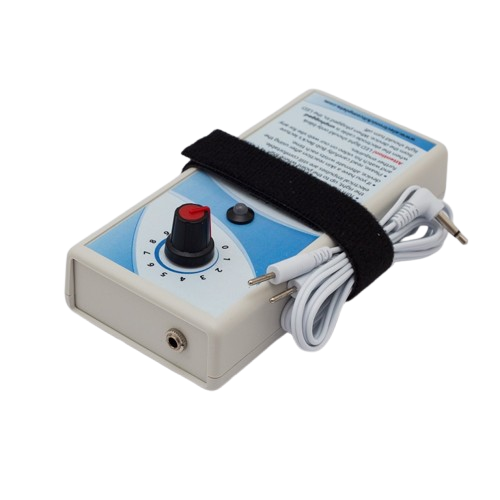
On the other end of the spectrum are devices designed for targeted use. These can be handheld probes, pads, or mats that apply an electric field to a specific part of the body, like a knee or shoulder. This approach is common for personal, at-home use where the focus is on a localized area. While these personal devices focus on general wellness, the principle of applying localized electric fields is also being explored in advanced medical research, such as the FDA-approved Tumor Treating Fields therapy for certain cancers.
Reported Uses in General Wellness
People who use electrostatic therapy are typically aiming for general wellness support, not to treat a specific illness. The most commonly reported goals include:
- Promoting a sense of relaxation and reducing feelings of stress.
- Supporting better sleep quality and waking with more energy.
- Helping the body maintain its natural electrical balance, or homeostasis.
Important Disclaimer: It is crucial to understand that devices and techniques described here are for general wellness and experimental purposes only. They are not medical devices. Electrostatic field therapy is not intended to diagnose, treat, cure, or prevent any disease. Always consult with a licensed healthcare professional for any health concerns or before starting any new wellness regimen.
Navigating Safety, Research, and Expectations
Exploring any new wellness modality brings up valid questions about safety, effectiveness, and what you can realistically expect. When it comes to something like electrostatic field therapy, it’s wise to approach it with an informed and curious mindset. Let’s address these points directly so you can make a decision that feels right for you.
General Safety Considerations
Your safety is the top priority. The fundamental principle is that high voltage is not the same as high current. These devices operate with high voltage but extremely low current, which is why they are generally considered safe when used correctly. However, certain precautions are essential:
- Always follow manufacturer instructions to the letter.
- Do not use if you have a pacemaker, cochlear implant, or other metallic implants.
- It is advised that pregnant women avoid this and other forms of electrotherapy.
The State of the Research
I believe in being transparent: you won’t find a wealth of mainstream, Western clinical trials on this topic. Much of the formal research comes from countries like Japan and Russia, where it has been explored for decades. In the West, the evidence is largely anecdotal, based on the personal experiences of thousands of individuals. This doesn’t invalidate the results; it just means you should be your own researcher and think critically.
Setting Realistic Expectations
Think of using an electrostatic field therapy device as one tool in your wellness toolkit, not a magic bullet. It is a modality for exploration and supporting your body’s natural energetic balance. Results can vary significantly from person to person based on individual sensitivity and consistency of use. I often suggest keeping a simple journal to track your feelings and experiences before and after sessions. This is the best way to gauge what it’s doing for you.
For those interested in bio-electricity, learning about the Bob Beck protocol is a great next step.
Embracing the Potential of Bio-Electric Principles
As we’ve seen, the world of bio-electricity is not a modern fad but a field with deep historical roots. From its early pioneers to modern applications, the fundamental concept remains: our bodies are intricate electrical systems. Understanding the principles behind electrostatic field therapy opens a door to new perspectives on wellness, reminding us that subtle energy can have a profound influence.
If you’re ready to move from theory to hands-on exploration, we invite you to discover the principles of bio-electric wellness with our research kits. Based on the foundational research of pioneers like Bob Beck, our kits are designed to empower your journey. We provide personal support for your electronic exploration and offer worldwide shipping, ensuring you have everything you need to begin. The path to understanding starts with a single step, and we’re here to help you take it.
Frequently Asked Questions
Is electrostatic therapy the same as PEMF therapy?
That’s a great question, and it’s easy to get them mixed up. No, they are not the same. Electrostatic therapy uses a static electric field, like the kind that makes your hair stand on end. PEMF, or Pulsed Electromagnetic Field therapy, uses a pulsing magnetic field. One creates a field of potential energy your body can sit in, while the other sends magnetic waves through the body. Both use energy, but the type and application are fundamentally different.
What does electrostatic field therapy feel like?
For most people, it feels like… well, nothing at all! You won’t feel a shock or a strong sensation, as the field itself is very subtle. Some users report a gentle feeling of warmth, relaxation, or a very light tingling in their hands or feet after a session, but many feel nothing during the actual therapy. The experience is typically very passive and relaxing; you simply sit or lie down and let the device do its work.
Are there any scientific studies on electrostatic therapy for wellness?
You’ll find a lot of research on this, especially from Japan where this technology is very popular for wellness. While it may not be mainstream in North America, many studies explore its effects on things like circulation, sleep, and general vitality. We encourage everyone to do their own research. A quick search for terms like “high-potential therapy” or “E-Vitalizer” in scientific databases will show you what researchers around the world have been discovering for decades.
How is electrostatic therapy different from a TENS machine?
They work in completely different ways. A TENS machine sends a direct electrical current through sticky pads on your skin to block pain signals in your nerves. It’s a very targeted, hands-on approach. In contrast, electrostatic field therapy creates a high-voltage, low-current field around your entire body. You’re not passing a current *through* you; you’re sitting *within* a field of energy. Think of it as soaking in an energy bath versus getting a targeted massage.
Can you use electrostatic therapy every day?
Yes, many people incorporate it into their daily routine, much like exercise or meditation. Sessions are typically short, often ranging from 15 to 30 minutes once or twice a day. The key is consistency. As with any wellness tool, it’s wise to listen to your body and see what feels best for you. We are not doctors, so if you have specific health concerns, it’s always a good idea to chat with a trusted healthcare professional first.
What kind of maintenance do these devices require?
One of the best things about these devices is their simplicity. They are built with solid-state electronics and have no moving parts, so maintenance is minimal. Basically, just keep the device and its mat clean and dry. A simple wipe-down with a dry cloth is all that’s usually needed. They are designed to be reliable and work for years without any special upkeep. Just plug it in, and you’re ready to go.