Simple Exercises to Strengthen Your Lower Back: A Beginner’s Guide
That familiar, nagging ache in your lower back… it’s more than just an annoyance, isn’t it? It’s a constant reminder that holds you back. You know that simple exercises to strengthen lower back muscles are the answer, but the fear of making the pain worse, or feeling overwhelmed by complex fitness advice, can be paralyzing-especially if you spend most of your day sitting. What if I told you that the path to a resilient, pain-free back isn’t found in a complicated gym routine, but in a few gentle movements you can do right at home?
That’s exactly what this guide is for. Think of it as your personal roadmap away from discomfort. We’re going to walk through a handful of beginner-friendly movements, with clear, step-by-step instructions. You’ll learn how to build a foundation of strength safely, helping you not only reduce that persistent ache but also improve your posture and prevent future injuries. It’s time to stop worrying and start building a back that supports you with confidence.
Why Your Lower Back Needs Support: Understanding the Root Causes
If you’re dealing with a nagging lower back ache, you’re not alone. But it’s crucial to understand that the pain itself is often just a symptom-a loud signal from your body that something is out of balance. For many of us, the root cause is surprisingly simple: our modern lifestyle. The very chairs we sit in for hours are contributing to a hidden weakness in the muscles designed to support our spine. A deeper look into understanding low back pain reveals that while causes can be complex, many roads lead back to muscular imbalance and weakness.
The old advice to “just rest” is often counterproductive for chronic aches. Instead, the key is to adopt a proactive approach. By focusing on gentle, consistent movement, you can begin to address the source of the problem. This isn’t about pushing through sharp pain, but about re-educating your body and building a foundation of strength that provides lasting relief. The goal is to move from managing pain to building resilience.
The Core Connection: Your Back’s Best Friend
When people hear “core,” they often picture six-pack abs. But your true core is a deep, three-dimensional system of muscles that includes your diaphragm, pelvic floor, and the deep abdominal and back muscles. Think of these muscles as a natural corset or the support cables on a bridge. They wrap around your torso, stabilizing your spine and pelvis with every step you take, every object you lift, and even as you sit. When this system is strong and active, it distributes pressure evenly, protecting your lower back from strain.
Common Culprits: Sitting, Poor Posture, and Weak Glutes
Our bodies are designed for movement, yet many of us spend most of the day sitting. This has a direct and damaging effect on our back’s support system. Here’s how:
- Deactivated Glutes: Prolonged sitting essentially puts your glute muscles to sleep. Since the glutes are a primary power source for movement, their inactivity forces smaller, less-equipped muscles-like those in your lower back-to pick up the slack.
- Lower Back Overload: When your lower back is constantly overcompensating for weak glutes and a disengaged core, it becomes strained, tight, and painful.
- Poor Posture: Slouching in a chair puts continuous, uneven pressure on your lumbar vertebrae and discs, leading to chronic stress and discomfort.
Recognizing these culprits is the first step. The next is taking action with specific exercises to strengthen lower back stability and wake up those sleepy support muscles. By rebuilding this foundation, you can turn your body’s own structure into its best defense against pain.
The 3 Pillars of a Resilient Back: Core, Glutes, and Mobility
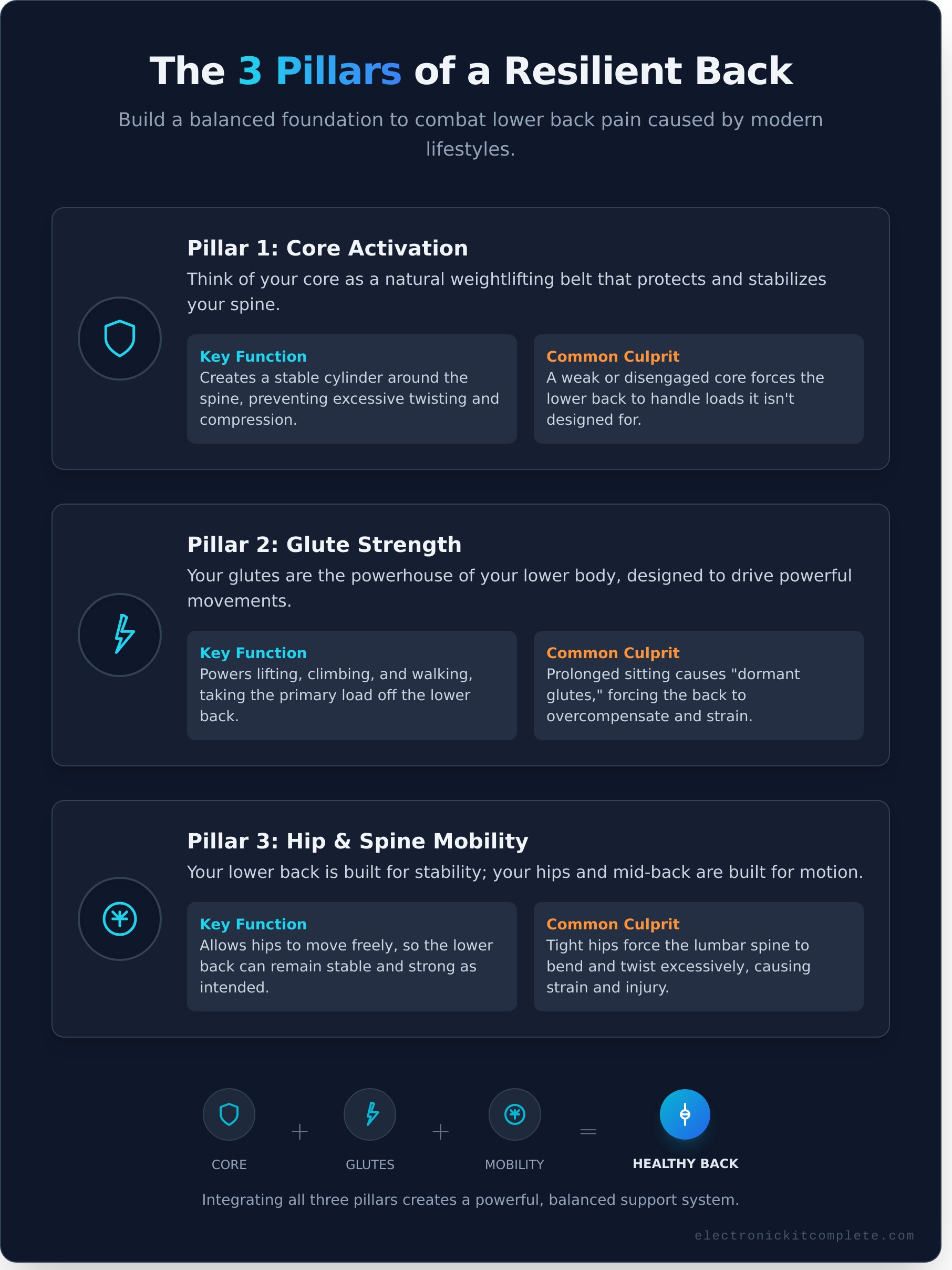
To truly protect your spine, you need to think beyond the back itself. A resilient lower back is built on a strong foundation supported by three crucial pillars: your core, your glutes, and your mobility. Focusing on only one area is like trying to build a stable stool with only one leg. The most effective exercises to strengthen lower back don’t just isolate back muscles; they integrate this entire support system. Understanding how these areas work together is a key prevention strategy, a concept supported by resources like this Low Back Pain Information fact sheet from the National Institute of Neurological Disorders and Stroke. By addressing all three pillars, you create a balanced, powerful foundation that reduces strain and promotes long-term health.
Pillar 1: Activating Your Core Stabilizers
Think of your core as a natural weightlifting belt. We’re not talking about the “six-pack” muscles, but the deep stabilizers like the transverse abdominis that wrap around your midsection. The goal here is endurance, not just brute force. Learning to engage these muscles through proper breathing-a gentle tightening as you exhale-creates a stable cylinder that protects your spine from excessive twisting and compression during movement.
Pillar 2: Waking Up Your Glutes
Your glutes are the powerhouse of your lower body, designed to drive powerful movements like lifting, climbing, and even walking. However, due to modern sedentary lifestyles, many people suffer from “dormant” glutes. When your glutes don’t fire properly, your lower back is forced to compensate, leading directly to overuse and pain. The initial focus of these exercises is activation-teaching your brain to use these powerful muscles again.
Pillar 3: Unlocking Hip and Spine Mobility
Stiffness in one area often causes instability in another. Your hips are designed for a wide range of motion, while your lower back is built for stability. When your hips are tight, your lumbar spine is forced to bend and twist excessively to pick up the slack. Gentle mobility work that improves your hip and thoracic (mid-back) spine’s range of motion allows your lower back to do its real job: staying stable and strong, which significantly reduces strain during daily activities.
5 Foundational Exercises to Build Lower Back Strength
Before you can lift heavy or move with power, you need a strong foundation. These foundational exercises to strengthen lower back stability are your starting point. The goal here is not speed or a high number of repetitions; it’s about slow, controlled movements. As studies published in The New York Times have shown, simple exercises to ease lower back pain are incredibly effective because they teach your body to activate the right muscles. Focus on the mind-muscle connection-feel your core and glutes doing the work, not your lower back.
1. Bird-Dog: The Ultimate Core Stabilizer
The bird-dog teaches your core to remain stable while your limbs are in motion, a key skill for protecting your spine during daily activities.
- Start on all fours with your hands directly under your shoulders and your knees under your hips.
- Engage your core to keep your back flat, like a tabletop.
- Slowly extend your right arm straight forward and your left leg straight back, keeping your hips and shoulders square to the floor.
- Hold for 2-3 seconds, then slowly return to the starting position.
- Repeat on the other side. That’s one rep.
What to Avoid: Don’t arch your lower back as you lift your leg or let your hips rotate. Imagine a glass of water resting on your lower back that you don’t want to spill.
2. Glute Bridge: Firing Up Your Powerhouse
Weak glutes often force the lower back to overcompensate. The glute bridge isolates and strengthens your glutes and hamstrings, providing powerful support for your spine.
- Lie on your back with your knees bent, feet flat on the floor about hip-width apart, and your arms by your sides with palms down.
- Engage your core and squeeze your glutes to lift your hips off the floor until your body forms a straight line from your shoulders to your knees.
- Hold at the top for 2-3 seconds, squeezing your glutes firmly.
- Slowly lower your hips back to the floor.
What to Avoid: Avoid lifting your hips so high that you arch your lower back. The power should come from your glutes, not from spinal extension.
3. Plank: Building Full-Body Tension
The plank is a classic for a reason. It builds isometric strength and endurance throughout your core, which is essential for maintaining good posture and protecting your back.
- Place your forearms on the floor with your elbows directly beneath your shoulders and hands clasped. (For a high plank, place your hands on the floor instead of your forearms).
- Extend your legs back, resting on your toes.
- Engage your core, glutes, and quads to create a straight, rigid line from your head to your heels.
- Hold this position without letting your hips sag or rise.
What to Avoid: Don’t let your lower back droop toward the floor or your hips pike up toward the ceiling. Keep your neck in line with your spine by looking at the floor just in front of your hands.
4. Cat-Cow: Mobilizing Your Spine
While not a strengthening exercise in the traditional sense, Cat-Cow improves spinal flexibility and relieves tension. It’s an excellent warm-up or cool-down movement.
- Start on all fours, in the same position as the bird-dog.
- Cow Pose: Inhale as you drop your belly towards the mat, lifting your chest and tailbone to look forward.
- Cat Pose: Exhale as you press into your hands, rounding your spine toward the ceiling and tucking your chin to your chest.
- Flow smoothly between the two poses, linking each movement to your breath.
Pro Tip: Focus on initiating the movement from your tailbone and letting it ripple up your spine. This gentle motion helps increase awareness of your back’s position.
Gentle Stretches for Immediate Relief and Flexibility
While building strength is crucial, the most effective programs of exercises to strengthen lower back also include gentle stretching. Think of stretching as the perfect complement; it’s how you release the tension that accumulates during the day or after a workout. These simple movements are designed to improve your flexibility, speed up recovery, and provide that “ahhh” feeling of immediate relief for an aching back.
Remember the golden rule: move into each stretch slowly and hold it gently. You should never bounce or force a position that causes sharp pain. A comfortable pull is all you need. We recommend doing these after your strengthening routine or at the end of a long day to help your body unwind.
Knee-to-Chest Stretch
This is a classic for a reason. Lie on your back with your knees bent and feet flat on the floor. Gently bring one knee up and pull it toward your chest with your hands until you feel a comfortable stretch in your lower back. For a deeper stretch, bring both knees to your chest. The key is to keep your head and shoulders completely relaxed on the floor, letting the stretch do the work of lengthening those tight lumbar muscles.
Pelvic Tilt
This subtle but powerful move awakens your deep core muscles. While lying on your back with your knees bent, feet flat, gently flatten your lower back against the floor by tightening your stomach muscles and slightly tilting your pelvis upward. It’s a very small, controlled movement-you are not lifting your hips into a bridge. Hold for a few seconds and release. This simple activation helps reset your spine’s position and releases built-up tension.
Lower Back Rotational Stretch
To target the muscles along the sides of your spine (like the QL), lie on your back with your knees bent and held together. Keeping your shoulders firmly planted on the floor, gently lower both knees to one side. You should feel a wonderful stretch through your lower back and hip. Hold here, breathing deeply, before returning to the center and repeating on the other side. This is one of the most valuable complementary movements to add to your routine of exercises to strengthen lower back.
Incorporating these simple stretches can make a world of difference in your daily comfort. We believe in empowering people with straightforward, effective tools for their well-being, a principle we apply to all our work at electronickitcomplete.com.
Creating a Sustainable Routine for Long-Term Back Health
You’ve learned the moves, but the real secret to lasting relief isn’t performing the perfect exercise once; it’s building a simple, repeatable habit. When it comes to your back, consistency will always be more powerful than intensity. Pushing too hard can lead to setbacks, but gentle, regular movement builds a foundation of strength and resilience. Think of this as a long-term investment in your body’s structural integrity.
These exercises to strengthen lower back muscles are most effective when they become part of your life, not just a temporary fix.
Sample Beginner’s Routine
Aim to complete this short routine 3 times per week on non-consecutive days (e.g., Monday, Wednesday, Friday). This gives your muscles time to recover and adapt. Remember to start with fewer reps and focus on perfect form.
- Mobility Warm-up (2 mins): Start with 10-12 slow and controlled Cat-Cow stretches to gently wake up your spine.
- Strength Work (5-7 mins): Perform 2 sets of 8-10 reps of the Bird-Dog (per side) and Glute Bridges. Rest for 30 seconds between sets.
- Cool-down Stretch (1-2 mins): Finish with a Knee-to-Chest stretch, holding each leg for 30 seconds to release tension.
Listen to Your Body: ‘Good Pain’ vs. ‘Bad Pain’
Understanding your body’s signals is crucial. Not all discomfort is created equal.
- Good Pain: This feels like muscle fatigue, a dull ache, or the gentle tension of a good stretch. It means your muscles are being challenged and are getting stronger.
- Bad Pain: Stop immediately if you feel anything sharp, shooting, stabbing, or radiating down your leg. This is your body’s warning signal.
Beyond Exercise: Simple Lifestyle Adjustments
Supporting your back isn’t just about the 15 minutes you spend on the mat. Small changes in your daily habits can make a huge difference:
- Break Up Sitting: Set a timer to stand up, stretch, and walk around for a minute every 30-60 minutes.
- Lift with Your Legs: When picking something up, bend at your knees and hips, keeping your back straight. Engage your core and let your powerful leg muscles do the work.
- Support Your Spine 24/7: Pay attention to your sleep posture-a pillow between the knees can help align your spine if you’re a side sleeper. Supportive footwear can also reduce daily strain on your lower back.
This journey is about empowering yourself with knowledge and simple tools. For those interested in exploring other unique approaches to personal wellness, you might find our work at Electronic Kit Complete interesting.
Your Journey to a Stronger, Pain-Free Back
You’ve now seen that a resilient lower back isn’t about complex gym routines, but about understanding your body’s natural design. By consistently focusing on strengthening your core and glutes while improving your mobility, you are building a powerful support system from the ground up. These foundational exercises to strengthen lower back are your first step toward restoring that natural function and finding lasting relief.
Taking this proactive approach is an empowering feeling. It’s about working with your body, not against it. If you believe in restoring natural body function and are ready to continue this journey, we invite you to explore more non-drug approaches to health and well-being. Join a community focused on self-managed health and discover new ways to support your body’s innate ability to heal.
Remember, every small, consistent step you take today is building a stronger, more resilient you for tomorrow. You have the power to make a change.
Frequently Asked Questions
How long will it take to feel a difference in my lower back?
Consistency is the most important factor when doing exercises to strengthen lower back. While everyone’s body is different, most people start to notice less stiffness and more support in about two to four weeks of regular practice, aiming for 3-4 sessions per week. It’s not about an instant fix, but about building a strong, resilient foundation over time. Be patient with your body and trust the process of gradually building strength.
Are these exercises safe to do if I already have back pain?
For most mild, chronic aches, these gentle movements are not only safe but highly beneficial. The key is to listen to your body. You should feel a gentle stretch or muscle engagement, not sharp or radiating pain. If a specific movement hurts, stop immediately. Of course, if you have a known injury or your pain is severe, it is always best to check with a healthcare professional before you begin any new routine.
What are the worst exercises for lower back pain that I should avoid?
You should generally avoid exercises that put direct, compressive force on the spine or involve improper form. Traditional sit-ups and double leg lifts can strain the lower back. Similarly, standing toe touches can overstretch sensitive muscles and ligaments. Heavy lifting with a rounded back is also a major risk. The focus should always be on controlled movements that support the spine, not ones that compress or twist it aggressively.
Can I do these lower back exercises every day?
While these exercises are gentle, your muscles still need time to recover and rebuild. Doing them every single day might lead to fatigue rather than strength. A better approach is to aim for 3 to 5 times per week, allowing for at least one or two rest days in between. This gives your body the chance to get stronger and helps you stay consistent in the long run without burning out.
Do I need any special equipment for these exercises?
Absolutely not. One of the best things about these simple exercises to strengthen lower back is that they use your own body weight for resistance. You don’t need any expensive gym memberships or fancy gadgets. All you need is a small, clear space on the floor. A yoga mat or a soft carpet can make things more comfortable, but it’s not a requirement. It’s all about effective movements you can do anywhere, anytime.
When should I see a doctor or physical therapist for my back pain?
You should see a professional if your pain is severe, doesn’t improve after a few weeks of gentle exercise, or resulted from a specific injury. It’s especially important to seek help if you experience numbness, tingling, or weakness in your legs. Any pain accompanied by issues with bladder or bowel control requires immediate medical attention, as these can be signs of a more serious condition that needs professional diagnosis and treatment.